One audio core on the phone, the computer and in the browser
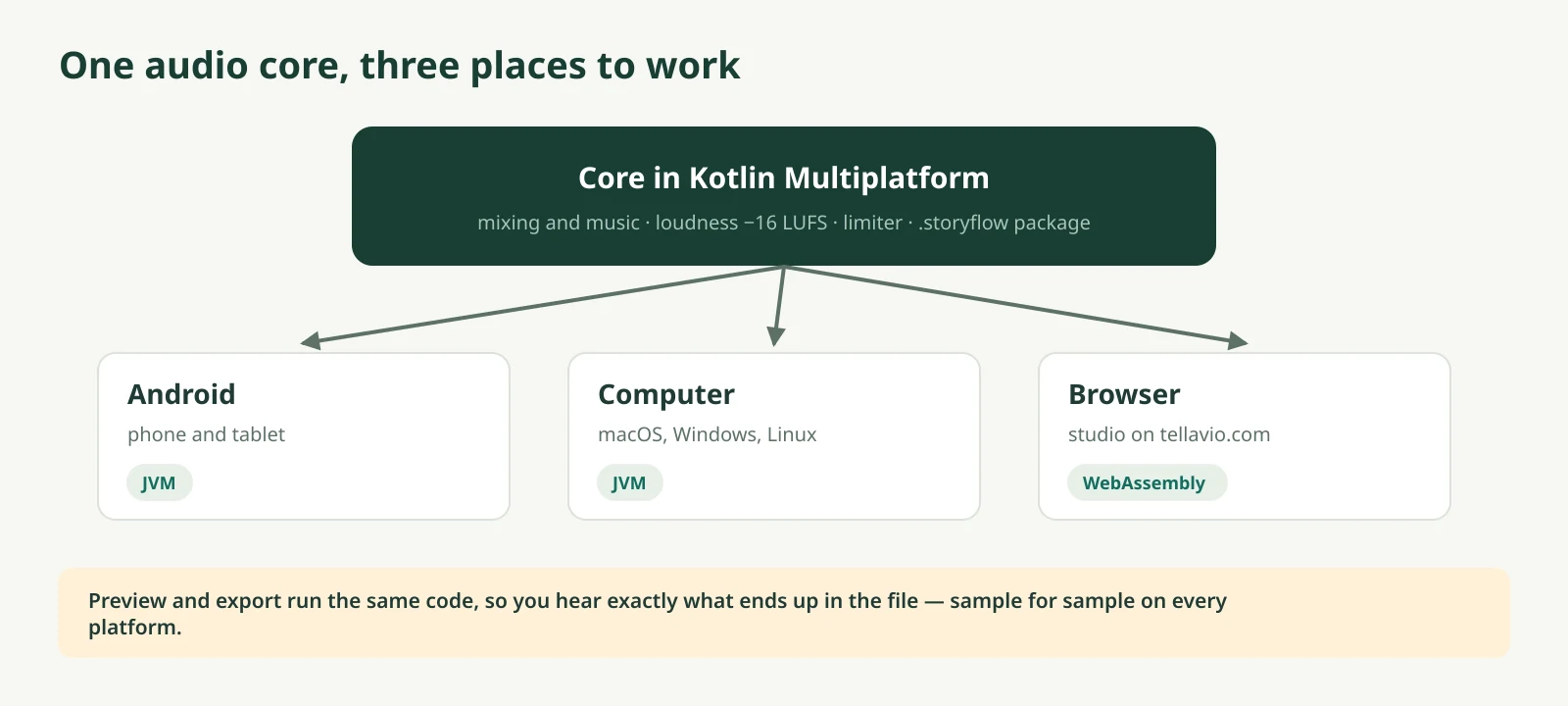
Over time Tellavio grew beyond Android. The desktop version and the browser studio use the same audio code as the phone app, so the mix sounds the same everywhere, down to the sample.
The sixth post in the series about how Tellavio is being built.
The specification did not plan for a desktop or a browser version. On 6 October, however, we decided that both would come, on the same terms as the app: local work, no account and no uploading of recordings.
The core first
If every version had its own mixing code, after a few months each would sound slightly different. So on 6 October we moved the whole audio core to Kotlin Multiplatform. The same code calculates the voice and music mix, loudness levelling, the limiter, and reading and writing .storyflow packages. On Android and the computer it runs on the Java virtual machine, in the browser as WebAssembly.
Tellavio on the computer
Since 19 October we have been building a desktop version (macOS, Windows, Linux). It shares the Android app’s database, the same block-based recording format with a log, and crash recovery. By 22 October it already had the project list, the script, recording from a chosen microphone, playback, takes, WAV export, a sound library with drag and drop, and project packages.
The best test was simple. We opened a package with a real project from the tablet on the computer. The recordings had the same checksums, and the export from the computer hit the target loudness of −16 LUFS. A package from the computer opened on the tablet. The computer is also the natural place for a USB microphone, so the app remembers the chosen microphone by name and keeps the system from sleeping during a take.
The desktop version is not available for download yet. It is waiting for signed installers and a manual pass through every screen.
A studio in the browser
On 9 November the browser studio arrived. First we had to decide what to build it with. The interface could have used the same technology as the app (Compose), but it draws everything on a canvas, and screen readers handle that poorly. We chose a regular web page (Next.js) on tellavio.com, because every control needs a name for screen readers.
The audio core went into the browser as WebAssembly. A measurement settled it. Mixing 10 minutes of material took 4.5 s in Chrome and 13 s in Firefox. The same core compiled to plain JavaScript needed 58 s and 106 s. Something else mattered even more: WebAssembly gives samples bit-identical to the phone and desktop versions. The JavaScript build calculates fractions with a different precision. The differences are inaudible, but tests that compare files byte by byte would stop working.
The studio records in blocks with a log like the phone, recovers a take after the tab is closed, exports WAV, reads and writes .storyflow packages and works offline after the first visit. Your data stays in the browser, on your computer.
The studio is now live on tellavio.com at /en/studio, as a first version (0.1). We have checked it in Chrome and Firefox with a simulated microphone; tests with a real microphone, in Safari and with a package from the tablet are still under way.
Next time: how Tellavio became the narrator app for Pointale audio guides.