Pitfalls along the way and what comes next
Six weeks of the project in one place, a few pitfalls that cost us the most time, and the plan for the coming months.
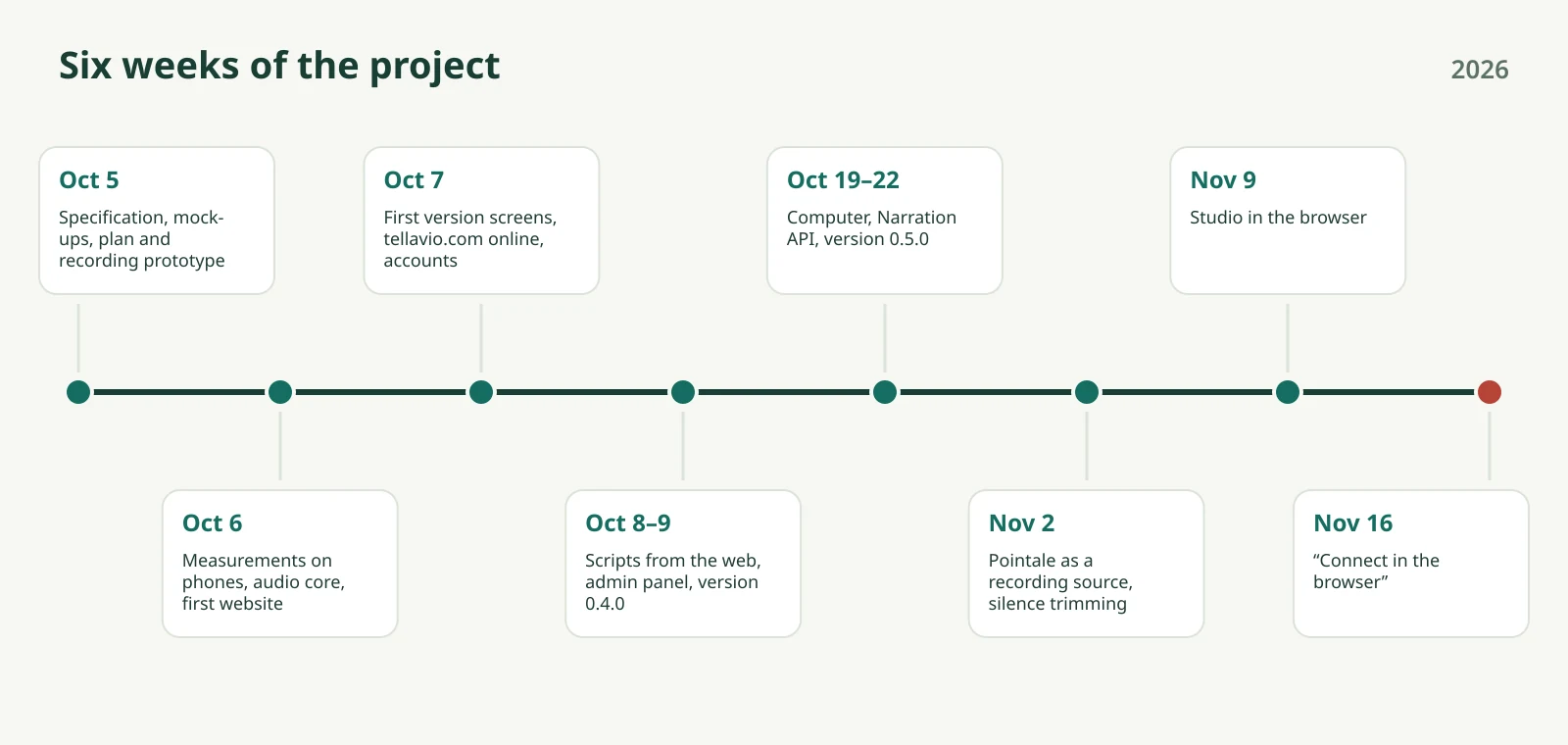
The eighth and last post in the series about how Tellavio is being built.
On a timeline everything looks smooth. In practice, the things that took the most time were not in any plan. Here are a few of them, without technical jargon wherever possible.
An export that waited for no reason
The first export measurements on the phone were disappointing. The cause turned out to be trivial: the code handing audio to the AAC encoder waited 10 milliseconds for an answer after every chunk of data. After the fix, the same export of 2 minutes of material took 34 s instead of 77 s.
A phone that slows down when it warms up
On longer exports the Galaxy S21 Ultra was about three times slower than the Tab S7+ tablet. Repeated runs on a low, warm phone kept slowing down regardless of the code. The lesson: we measure performance on a charger and after the phone has cooled down, otherwise we compare temperatures, not code.
Loudness a hair off target
The test comparing preview and export caught a bug you cannot hear. When the limiter worked hard, the finished file came out at −16.6 LUFS instead of −16. Now the app measures loudness a second time after the limiter and corrects it.
A test that wiped the data
On 8 October the app’s automated tests uninstalled it from a test phone together with its data. That is how the Android tooling behaves by default. The test projects were gone. Since then the tests leave the app installed, and we back up the device data before running them.
Fractions calculated differently in the browser
The audio core compiled to JavaScript calculated fractions with a different precision than on the phone. The difference was around −131 dBFS, far below anything audible. But the tests that compare output byte by byte with the phone would have stopped working. That settled the choice of WebAssembly.
Two apps, one return address
When you sign in through the browser, the browser returns to the app via the address tellavio://connect. The test build and the release build register the same address. With both installed, Android asks which one to open, and picking the wrong one ends with the error “The connection took too long or was interrupted”. Eventually we will switch to a regular https address on tellavio.com, which Android assigns to one app only.
Shorter recordings without silence
Not everything was a pitfall. On 2 November the app gained automatic trimming of silence at the start and end of a take, without changing the original, of course. A few days later projects from services started to include the intro, the title and headings as separate parts to read.
What comes next
The next steps from the plan:
- Google Play. Closed testing, the data safety form and the background recording declaration. Until then you can download the app from tellavio.com.
- Connect in the browser. Tests on devices once the services launch their consent pages.
- Computer. Signed installers for macOS and Windows.
- Browser studio. Version 0.1 is already live on tellavio.com; next come tests with a real microphone and in Safari. M4A export only after we have checked that we can include it safely.
- More interface languages after Polish and English.
The app is meant to stay free. Paid extras may come, for example syncing projects with recordings between devices. Everything described in this series is meant to work without them.
Thank you for reading the whole series. New posts will appear here whenever there is something worth telling.